2026-27 Winter
Get ready for a super El Niño winter. Kind of harrowing for the planet, but this means, fingers crossed, that we will not be experiencing winter as cold as last year’s.

In what may be an interesting repeat of the 2015-2017 El Niño cycle, in which we have an incredible, intense winter followed by two really mild winters (see chart below, in the 2025-26 Retrospective section), we may be experiencing, on average, less snow and higher average temperatures throughout the winter.
No comparative price predictions yet, but we know that in warmer winters, heat pumps tend to be more efficient. And given the elevated price of oil with our Middle East adventures, I do expect heat pumps to be a little better than oil this coming winter, if not on par with gas.
More to come.
2025-26 Retrospective
Yeah. It was a super intense winter. We anticipated that using heat pumps would more or less be around the same as the cost of heating with oil, given the lower efficiency at super cold temperatures.
LC member Jeremy from Ashland, who installed a Daikin and a LG condenser, validates this prediction based on his personal experience in 2025-26 winter:
After one month with the heat pumps, we used 1,273 kWh of electricity compared with 411 kWh the previous month. Based on this the heat pumps used roughly 850 kWh of electricity with an average rate per kWh of 0.247 cents. This is with the heat pump rate and a reduced supply cost through our town’s municipal aggregation rate.
This comes out to ~$210 to heat our 1,100 sq foot house in a month where the average temperature was 29.5°F.
I don’t know how much oil would have cost since we moved in this summer, but in October, November and the first week of December we used ~65 gallons of oil. The oil delivery company quoted us a price of $3.24 per gallon which is interestingly pretty much exactly $210. Of course, October through 1 week of December is significantly longer than one month but also significantly warmer. Oil prices also tend to go up over the winter.
Another way to estimate how much oil we would have used is based on energy content. There are ~3,412 BTUs per kWh. At 5°F the COP of the Daikin & LG [heat pumps] are 1.9 and 1.85 respectively. At 17°F the Daikin is rated at a COP of 2.9 but if running at minimum capacity the COP actually drops to 2.49. LG is rated at a COP of 2.59 at 17 but at minimum capacity it is only 2.5. If we use a COP of 2.5 as a pessimistic average, that would imply we used ~7,250,500 BTUs of heat. (850 kWh for heating * 3412 BTU per kWh * COP of 2.5). If our actual average COP was higher this would imply we used more BTUs. There are 138,500 BTUs per gallon of heating oil. At the last test our old oil furnace was 79% efficient, implying we get 109,425 usable BTUs per gallon. That would imply we would have used 66.25 gallons of oil or $214 at $3.24 per gallon.
That’s basically the same as the previous estimate! Looks like we basically broke even in terms of energy cost or maybe saved a little money.
Side note: MA really needs to do something about high electric costs. With the heat pump rate and a cheaper municipal aggregation rate we are at break even with an old inefficient oil furnace. That’s not great math for a state looking to drive heat pump adoption.
So, in conclusion, I can say: given a very cold winter and prevailing fuel prices at the start of 2026, heating with heat pumps is just about the same cost as heating with oil.
2025-26 Winter
We have an update! Here’s Figure 2 from this year’s projections:
Ladies and gentlemen, the cost of every fuel type has dropped relative to last year, partly due to an uproar about energy prices which is now a hot political issue across all of America. State lawmakers, the DOER/DPU & the Healey administration have been making various attempts to lower costs, and this is partly the outcome. (In some cases, we joined the conversation1.)
What I will say is this:
The primary benefit of heat pumps is still getting AC, rather than saving money
If you’re switching from an older, less efficient gas system, then you might see some savings - but it won’t be a lot
This changes if you have solar. You will probably save money if you have solar
This also changes with municipal electric, since rates are much lower
It’s always worth it to switch from resistance electric (the $101.73 on the chart)
It’s been a cold start this winter, but we’ll see soon if it’s as long as last winter. That’ll be a factor in heating costs, too.
2024-25 Winter
End-of-Winter Update: based on EIA data, the price of gas nationally has risen more than the price of electricity. Overall, every fuel type was in higher demand due to the colder winter.
August 2025 update: seasonal heat pump rates are here! Expect to save next winter.
This one takes like 10 seconds, because the great Department of Energy Resources in Massachusetts releases a report answering this exact question every year.
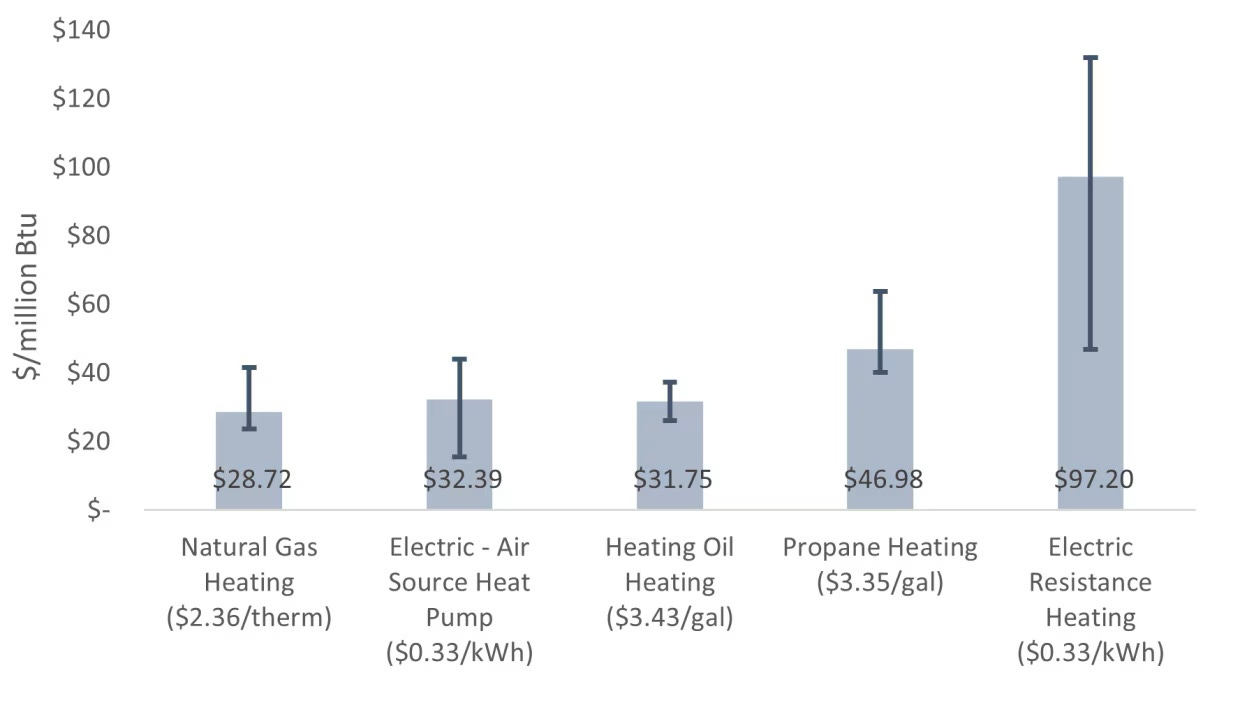
Here is this year’s report: Massachusetts Household Heating Costs. Figure 2:
So, 3 takeaways:
If you’re heating with natural gas, prices rose this year (Green Energy Consumers Alliance has a great blog on the reasons for this) and the gap between heating with heat pump vs. natural gas has narrowed to about 10% on average.
Oil & heat pump heating costs roughly at parity this year!!
Electric resistance, as always, remains the low hanging fruit at roughly 3x the cost of heating with heat pumps.
Most of our installations at LC are oil to heat pump conversions, so while it’s good to know that costs won’t go up, the main benefit of a heat pump now is really the AC, comfort, & rebate.
That, and not having a giant tank of oil in your basement.
The Equipment Factor
What about those error bars, though? Here’s how we think about that:
So, if you’re going from high efficiency gas boiler → low efficiency ducted heat pump, you’ll likely see higher costs. But if you have a super old furnace in an old house, and you decide to opt for mini-splits (which are more efficient than ducted systems), you’ll be way more likely to save money.
3/1 EIA Update
Natural gas going up by 10% is a bit of a surprise here. Rates differ in different markets based on public utility regulation, of course, but if trends hold, it would be interest to consider whether we have a triple-parity situation where heating with natural gas, heat pumps, and oil are essentially the same cost.
Caveat: Municipal Light Plants
If you live in any one of these towns, your electricity rate is like, half of EverSource/National Grid’s basic rates. While you may not get the $10k rebate from Mass Save, you WILL save a ton of money on heating bills switching to heat pumps.
For example, here’s Groveland coming in at half the cost of Eversource & NG:
If you’re in MLP territory, consider getting a heat pump!
Caveat: Heat Pump Specific Rates
Update: this is live for all utilities in 2025-26! TBD on opt-in or opt-out enrollment.
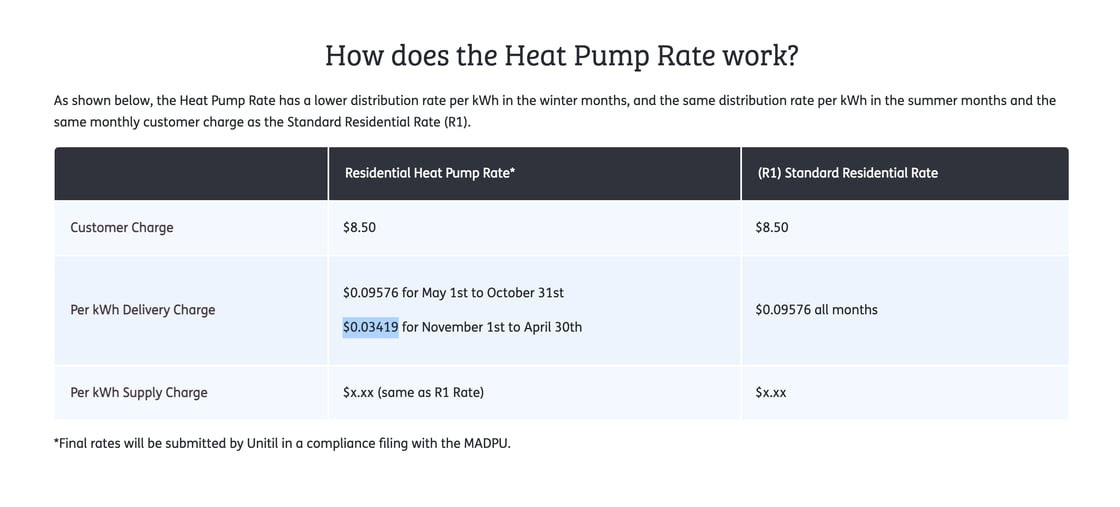
Unitil seems to be rolling out heat pump-specific rates soon. There's talk of National Grid looking to do the same thing.
How much would you save with this heat pump rate? It'll shave about 6 cents off. That's significant:
I don’t think this will rollout statewide this year, but we’ll keep an eye on this. It’ll be a factor in future years, along with the constantly shifting commodity prices of oil & gas.


